mirror of
https://github.com/fastfloat/fast_float.git
synced 2026-06-15 16:36:07 +08:00

747 lines
30 KiB
Markdown
747 lines
30 KiB
Markdown
|
||
## fast_float HE edition number parsing library.
|
||
[](https://github.com/irainman/fast_float/actions/workflows/ubuntu22.yml)
|
||
[](https://github.com/irainman/fast_float/actions/workflows/ubuntu22-clang.yml)
|
||
[](https://github.com/irainman/fast_float/actions/workflows/ubuntu24.yml)
|
||
[](https://github.com/irainman/fast_float/actions/workflows/ubuntu24-cxx20.yml)
|
||
[](https://github.com/irainman/fast_float/actions/workflows/alpine.yml)
|
||
[](https://github.com/irainman/fast_float/actions/workflows/vs17-ci.yml)
|
||
[](https://github.com/irainman/fast_float/actions/workflows/vs17-cxx20.yml)
|
||
[](https://github.com/irainman/fast_float/actions/workflows/vs17-clang-ci.yml)
|
||
[](https://www.codefactor.io/repository/github/irainman/fast_float)
|
||
[](https://codecov.io/github/IRainman/fast_float)
|
||
|
||
## This is a fork of [fast_float](https://github.com/fastfloat/fast_float) made by HedgehogInTheCPP with some additional options, code refactoring and big cleanup to maximize performance, reduce size and improve mainteinability, please give a star to this repo ^^
|
||
|
||
### 🚀 Performance and Code Size Improvements
|
||
|
||
* Optimized parsing logic for use as an **internal lightweight parser** (for example, inside other libraries).
|
||
* Reduced binary size by conditionally excluding unneeded parsing features.
|
||
* The `from_chars_result_t` structure is reduced to **4 bytes** for better memory efficiency.
|
||
* Improved the `parsed_number_string_t` layout and increased `constexpr`/`consteval` propagation to enable compile-time optimizations.
|
||
* Reduced register and cache pressure and branching in parsing hot paths.
|
||
* Improved performance in both 64-bit and 32-bit builds for all supported types.
|
||
|
||
---
|
||
|
||
### ⚙️ New Configuration Macros
|
||
|
||
Introduced new optional macros to minimize overhead when certain parsing features are not required:
|
||
|
||
* **`FASTFLOAT_ONLY_POSITIVE_C_NUMBER_WO_INF_NAN`**
|
||
Restricts parsing to **positive C-style numbers only** — no sign characters, no `INF`, `INFINITY`, or `NaN` and no additional options like skip white spaces or support for Fortran or JSON.
|
||
|
||
* **`FASTFLOAT_ONLY_ROUNDS_TO_NEAREST_SUPPORTED`**
|
||
Assumes that only the **IEEE 754 “round-to-nearest”** rounding mode is needed, removing crutches support code for other modes.
|
||
|
||
* **`FASTFLOAT_ISNOT_CHECKED_BOUNDS`**
|
||
Disables bounds checking for input ranges that are assumed to be valid.
|
||
Use only when inputs are guaranteed safe — this reduces branching and slightly improves performance.
|
||
|
||
* **`FASTFLOAT_ASSUME`**
|
||
Provides a portable abstraction for the compiler’s `[[assume]]` intrinsic.
|
||
|
||
* **`FASTFLOAT_HAS_BYTESWAP`**
|
||
Uses std::byteswap if available to reduce code size and speed up.
|
||
|
||
* **`FASTFLOAT_HAS_BIT_CAST`**
|
||
Uses std::bit_cast if available to reduce code size and speed up.
|
||
|
||
---
|
||
|
||
### 🧩 Remove Deprecated Macros
|
||
|
||
* Removed obsolete macroses **`FASTFLOAT_ALLOWS_LEADING_PLUS`** and **`FASTFLOAT_SKIP_WHITE_SPACE`**, which are now superseded by the stricter limited-mode options above.
|
||
|
||
---
|
||
|
||
### 🧠 Internal Refactoring and Quality Improvements
|
||
|
||
* Simplified internal parsing logic with compile-time branching controlled by the new macros.
|
||
* Enhanced `constexpr` coverage across the codebase for greater compile-time evaluation.
|
||
* Updated benchmarks and tests to validate new restricted configurations.
|
||
* Fixed minor compiler warnings and addressed **PVS-Studio** static analysis feedback.
|
||
* Properly use FASTFLOAT_SIMD_DISABLE_WARNINGS and FASTFLOAT_SIMD_RESTORE_WARNINGS only for instructions that allow unaligned loads.
|
||
* Many small cleanups and fixes.
|
||
* Added more comments about functionality and realization details.
|
||
|
||
---
|
||
|
||
### 📘 Documentation and Build
|
||
|
||
* Updated **README.md** to describe all new configuration macros and their intended use cases.
|
||
* Adjusted build scripts and benchmark configurations for the new compile-time flags.
|
||
|
||
---
|
||
|
||
✅ **Result:**
|
||
Smaller, [faster by default](https://github.com/fastfloat/fast_float/pull/307#issuecomment-3775676197), and more configurable builds — now library can be used for **internal numeric parsers** or **embedded environments** — while maintaining full compatibility, functionality, and performance improvements in the default configuration.
|
||
|
||
|
||
🔥 **Motivation:**
|
||
There is a really common use case in mathematical and other abstract syntax tree (AST)-like parsers that already processes
|
||
the sign and all other symbols before any number by itself. In this case you can use FastFloat to only parse positive numbers
|
||
in all supported formats with macros `FASTFLOAT_ONLY_POSITIVE_C_NUMBER_WO_INF_NAN`, which significantly reduce the code size
|
||
and improve performance. You also can use macros `FASTFLOAT_ISNOT_CHECKED_BOUNDS` if your code already checks bounds;
|
||
it's very likely because all parsers need to check the first character by itself before parsing. Additionally, you can use
|
||
macros `FASTFLOAT_ONLY_ROUNDS_TO_NEAREST_SUPPORTED` if you only need `FE_TONEAREST` rounding mode in the parsing; this option
|
||
also improves performance a bit and reduces code size. In the high-performance example, I also use the [fmt library](https://github.com/fmtlib/fmt), which also
|
||
supports all C++ standards since C++11. I also recommend using `string_view` everywhere if it's possible; it's available
|
||
since C++17, and if you want maximum performance, use the latest compiler with the latest C++ with maximum optimization (I use C++23 and some from C++26):
|
||
```
|
||
-O3 -DNDEBUG + LTO
|
||
```
|
||
```C++
|
||
#define FASTFLOAT_ONLY_POSITIVE_C_NUMBER_WO_INF_NAN
|
||
#define FASTFLOAT_ISNOT_CHECKED_BOUNDS
|
||
#define FASTFLOAT_ONLY_ROUNDS_TO_NEAREST_SUPPORTED
|
||
#include "fast_float/fast_float.h"
|
||
#include "fmt/base.h"
|
||
#include <string_view>
|
||
|
||
int main() {
|
||
std::string_view input = "23.14069263277926900572";
|
||
double result;
|
||
auto answer = fast_float::from_chars(input.data(), input.data() + input.size(), result);
|
||
if ((answer.ec != std::errc()) || ((result != 23.14069263277927 /*properly rounded value */)))
|
||
{
|
||
fmt::print(stderr, "parsing failure!\n the number {}.", result);
|
||
return 1;
|
||
}
|
||
fmt::print("parsed the number {}.", result);
|
||
return 0;
|
||
}
|
||
```
|
||
|
||
The fast_float library provides fast header-only implementations for the C++
|
||
from_chars functions for `float` and `double` types as well as integer types.
|
||
These functions convert ASCII strings representing decimal values (e.g.,
|
||
`1.3e10`) into binary types. We provide exact rounding (including round to
|
||
even). In our experience, these `fast_float` functions many times faster than
|
||
comparable number-parsing functions from existing C++ standard libraries.
|
||
|
||
|
||
Specifically, `fast_float` provides the following two functions to parse
|
||
floating-point numbers with a C++17-like syntax (the library itself only
|
||
requires C++11):
|
||
|
||
```C++
|
||
from_chars_result from_chars(char const *first, char const *last, float &value, ...);
|
||
from_chars_result from_chars(char const *first, char const *last, double &value, ...);
|
||
```
|
||
If they are available on your system, we also support fixed-width floating-point types such as `std::float64_t`, `std::float32_t`, `std::float16_t`, and `std::bfloat16_t`.
|
||
|
||
You can also parse integer types such as `char`, `short`, `long`, `long long`, `unsigned char`, `unsigned short`, `unsigned long`, `unsigned long long`, `bool` (0/1), `int8_t`, `int16_t`, `int32_t`, `int64_t`, `uint8_t`, `uint16_t`, `uint32_t`, `uint64_t`.
|
||
```C++
|
||
from_chars_result from_chars(char const *first, char const *last, int &value, ...);
|
||
from_chars_result from_chars(char const *first, char const *last, unsigned &value, ...);
|
||
```
|
||
|
||
The return type (`from_chars_result`) is defined as the struct:
|
||
|
||
```C++
|
||
struct from_chars_result {
|
||
char const *ptr;
|
||
std::errc ec;
|
||
};
|
||
```
|
||
|
||
It parses the character sequence `[first, last]` for a number. It parses
|
||
floating-point numbers expecting a locale-independent format equivalent to the
|
||
C++17 from_chars function. The resulting floating-point value is the closest
|
||
floating-point values (using either `float` or `double`), using the "round to
|
||
even" convention for values that would otherwise fall right in-between two
|
||
values. That is, we provide exact parsing according to the IEEE standard.
|
||
|
||
Given a successful parse, the pointer (`ptr`) in the returned value is set to
|
||
point right after the parsed number, and the `value` referenced is set to the
|
||
parsed value. In case of error, the returned `ec` contains a representative
|
||
error, otherwise the default (`std::errc()`) value is stored.
|
||
|
||
The implementation does not throw and does not allocate memory (e.g., with `new`
|
||
or `malloc`) and can be usable in the kernel, embeded and other scenarious that
|
||
relays on such behavior.
|
||
|
||
It will parse infinity and nan values.
|
||
|
||
Example:
|
||
|
||
```C++
|
||
#include "fast_float/fast_float.h"
|
||
#include <iostream>
|
||
#include <string>
|
||
|
||
int main() {
|
||
std::string input = "3.1416 xyz ";
|
||
double result;
|
||
auto answer = fast_float::from_chars(input.data(), input.data() + input.size(), result);
|
||
if (answer.ec != std::errc()) { std::cerr << "parsing failure\n"; return EXIT_FAILURE; }
|
||
std::cout << "parsed the number " << result << std::endl;
|
||
return EXIT_SUCCESS;
|
||
}
|
||
```
|
||
|
||
Prior to C++26, checking for a successful `std::from_chars` conversion requires comparing the `from_chars_result::ec` member to `std::errc()`. As an extension `fast_float::from_chars` supports the improved C++26 API that allows checking the result by converting it to `bool`, like so:
|
||
|
||
```cpp
|
||
#include "fast_float/fast_float.h"
|
||
#include <iostream>
|
||
#include <string>
|
||
|
||
int main() {
|
||
std::string input = "3.1416 xyz ";
|
||
double result;
|
||
if(auto answer = fast_float::from_chars(input.data(), input.data() + input.size(), result)) {
|
||
std::cout << "parsed the number " << result << std::endl;
|
||
return EXIT_SUCCESS;
|
||
}
|
||
std::cerr << "failed to parse " << input << std::endl;
|
||
return EXIT_FAILURE;
|
||
}
|
||
```
|
||
|
||
You can parse delimited numbers:
|
||
|
||
```C++
|
||
std::string input = "234532.3426362,7869234.9823,324562.645";
|
||
double result;
|
||
auto answer = fast_float::from_chars(input.data(), input.data() + input.size(), result);
|
||
if (answer.ec != std::errc()) {
|
||
// check error
|
||
}
|
||
// we have result == 234532.3426362.
|
||
if (answer.ptr[0] != ',') {
|
||
// unexpected delimiter
|
||
}
|
||
answer = fast_float::from_chars(answer.ptr + 1, input.data() + input.size(), result);
|
||
if (answer.ec != std::errc()) {
|
||
// check error
|
||
}
|
||
// we have result == 7869234.9823.
|
||
if (answer.ptr[0] != ',') {
|
||
// unexpected delimiter
|
||
}
|
||
answer = fast_float::from_chars(answer.ptr + 1, input.data() + input.size(), result);
|
||
if (answer.ec != std::errc()) {
|
||
// check error
|
||
}
|
||
// we have result == 324562.645.
|
||
```
|
||
|
||
Like the C++17 standard, the `fast_float::from_chars` functions take an optional
|
||
last argument of the type `fast_float::chars_format`. It is a bitset value: we
|
||
check whether `fmt & fast_float::chars_format::fixed` and `fmt &
|
||
fast_float::chars_format::scientific` are set to determine whether we allow the
|
||
fixed point and scientific notation respectively. The default is
|
||
`fast_float::chars_format::general` which allows both `fixed` and `scientific`.
|
||
|
||
The library seeks to follow the C++17 (see
|
||
[28.2.3.(6.1)](https://eel.is/c++draft/charconv.from.chars#6.1)) specification.
|
||
|
||
* The `from_chars` function does not skip leading white-space characters (unless
|
||
`fast_float::chars_format::skip_white_space` is set).
|
||
* [A leading `+` sign](https://en.cppreference.com/w/cpp/utility/from_chars) is
|
||
forbidden (unless `fast_float::chars_format::allow_leading_plus` is set).
|
||
* It is generally impossible to represent a decimal value exactly as binary
|
||
floating-point number (`float` and `double` types). We seek the nearest value.
|
||
We round to an even mantissa when we are in-between two binary floating-point
|
||
numbers.
|
||
|
||
Furthermore, we have the following restrictions:
|
||
|
||
* We support `float` and `double`, but not `long double`. We also support
|
||
fixed-width floating-point types such as `std::float64_t`, `std::float32_t`,
|
||
`std::float16_t`, and `std::bfloat16_t`.
|
||
* We only support the decimal format: we do not support hexadecimal strings.
|
||
* For values that are very large positives or negatives (e.g., `1e9999`), we
|
||
represent them using a positive or negative infinity and the returned
|
||
`ec` is set to `std::errc::result_out_of_range`.
|
||
* For values that are very close to zero (e.g., `1e-9999`), we represent them
|
||
using a positive or negative zero and the returned `ec` is set to
|
||
`std::errc::result_out_of_range`.
|
||
|
||
We support Visual Studio, macOS, Linux, freeBSD. We support big and little
|
||
endian. We support 32-bit and 64-bit systems.
|
||
|
||
We assume that the rounding mode is set to nearest (`std::fegetround() ==
|
||
FE_TONEAREST`).
|
||
|
||
## Integer types
|
||
|
||
You can also parse integer types using different bases (e.g., 2, 10, 16). The
|
||
following code will print the number 22250738585072012 three times:
|
||
|
||
```C++
|
||
#include "fast_float/fast_float.h"
|
||
#include <iostream>
|
||
|
||
int main() {
|
||
uint64_t i;
|
||
std::string str = "22250738585072012";
|
||
auto answer = fast_float::from_chars(str.data(), str.data() + str.size(), i);
|
||
if (answer.ec != std::errc()) {
|
||
std::cerr << "parsing failure\n";
|
||
return EXIT_FAILURE;
|
||
}
|
||
std::cout << "parsed the number " << i << std::endl;
|
||
|
||
std::string binstr = "1001111000011001110110111001001010110100111000110001100";
|
||
|
||
answer = fast_float::from_chars(binstr.data(), binstr.data() + binstr.size(), i, 2);
|
||
if (answer.ec != std::errc()) {
|
||
std::cerr << "parsing failure\n";
|
||
return EXIT_FAILURE;
|
||
}
|
||
std::cout << "parsed the number " << i << std::endl;
|
||
|
||
std::string hexstr = "4f0cedc95a718c";
|
||
|
||
answer = fast_float::from_chars(hexstr.data(), hexstr.data() + hexstr.size(), i, 16);
|
||
if (answer.ec != std::errc()) {
|
||
std::cerr << "parsing failure\n";
|
||
return EXIT_FAILURE;
|
||
}
|
||
std::cout << "parsed the number " << i << std::endl;
|
||
return EXIT_SUCCESS;
|
||
}
|
||
```
|
||
|
||
## Behavior of result_out_of_range
|
||
|
||
When parsing floating-point values, the numbers can sometimes be too small
|
||
(e.g., `1e-1000`) or too large (e.g., `1e1000`). The C language established the
|
||
precedent that these small values are out of range. In such cases, it is
|
||
customary to parse small values to zero and large values to infinity. That is
|
||
the behaviour of the C language (e.g., `stdtod`). That is the behaviour followed
|
||
by the fast_float library.
|
||
|
||
Specifically, we follow Jonathan Wakely's interpretation of the standard:
|
||
|
||
> In any case, the resulting value is one of at most two floating-point values
|
||
> closest to the value of the string matching the pattern.
|
||
|
||
It is also the approach taken by the [Microsoft C++
|
||
library](https://github.com/microsoft/STL/blob/62205ab155d093e71dd9588a78f02c5396c3c14b/tests/std/tests/P0067R5_charconv/test.cpp#L943-L946).
|
||
|
||
Hence, we have the following examples:
|
||
|
||
```cpp
|
||
double result = -1;
|
||
std::string str = "3e-1000";
|
||
auto r = fast_float::from_chars(str.data(), str.data() + str.size(), result);
|
||
// r.ec == std::errc::result_out_of_range
|
||
// r.ptr == str.data() + 7
|
||
// result == 0
|
||
```
|
||
|
||
```cpp
|
||
double result = -1;
|
||
std::string str = "3e1000";
|
||
auto r = fast_float::from_chars(str.data(), str.data() + str.size(), result);
|
||
// r.ec == std::errc::result_out_of_range
|
||
// r.ptr == str.data() + 6
|
||
// result == std::numeric_limits<double>::infinity()
|
||
```
|
||
|
||
Users who wish for the value to be left unmodified given
|
||
`std::errc::result_out_of_range` may do so by adding two lines of code:
|
||
|
||
```cpp
|
||
double old_result = result; // make copy
|
||
auto r = fast_float::from_chars(start, end, result);
|
||
if (r.ec == std::errc::result_out_of_range) { result = old_result; }
|
||
```
|
||
|
||
## C++20: compile-time evaluation (constexpr)
|
||
|
||
In C++20, you may use `fast_float::from_chars` to parse strings at compile-time,
|
||
as in the following example:
|
||
|
||
```C++
|
||
// consteval forces compile-time evaluation of the function in C++20.
|
||
consteval double parse(std::string_view input) {
|
||
double result;
|
||
auto answer = fast_float::from_chars(input.data(), input.data() + input.size(), result);
|
||
if (answer.ec != std::errc()) { return -1.0; }
|
||
return result;
|
||
}
|
||
|
||
// This function should compile to a function which
|
||
// merely returns 3.1415.
|
||
constexpr double constexptest() {
|
||
return parse("3.1415 input");
|
||
}
|
||
```
|
||
|
||
## C++23: Fixed width floating-point types
|
||
|
||
The library also supports fixed-width floating-point types such as
|
||
`std::float64_t`, `std::float32_t`, `std::float16_t`, and `std::bfloat16_t`.
|
||
E.g., you can write:
|
||
|
||
```C++
|
||
std::float32_t result;
|
||
auto answer = fast_float::from_chars(f.data(), f.data() + f.size(), result);
|
||
```
|
||
|
||
## Non-ASCII Inputs
|
||
|
||
We also support UTF-16 and UTF-32 inputs, as well as ASCII/UTF-8, as in the
|
||
following example:
|
||
|
||
```C++
|
||
#include "fast_float/fast_float.h"
|
||
#include <iostream>
|
||
|
||
int main() {
|
||
std::u16string input = u"3.1416 xyz ";
|
||
double result;
|
||
auto answer = fast_float::from_chars(input.data(), input.data() + input.size(), result);
|
||
if (answer.ec != std::errc()) { std::cerr << "parsing failure\n"; return EXIT_FAILURE; }
|
||
std::cout << "parsed the number " << result << std::endl;
|
||
return EXIT_SUCCESS;
|
||
}
|
||
```
|
||
|
||
## Advanced options: using commas as decimal separator, parse JSON, Fortran and more
|
||
|
||
The C++ standard stipulate that `from_chars` has to be locale-independent. In
|
||
particular, the decimal separator has to be the period (`.`). However, some
|
||
users still want to use the `fast_float` library with in a locale-dependent
|
||
manner. Using a separate function called `from_chars_advanced`, we allow the
|
||
users to pass a `parse_options` instance which contains a custom decimal
|
||
separator (e.g., the comma). You may use it as follows.
|
||
|
||
```C++
|
||
#include "fast_float/fast_float.h"
|
||
#include <iostream>
|
||
|
||
int main() {
|
||
std::string input = "3,1416 xyz ";
|
||
double result;
|
||
fast_float::parse_options options{fast_float::chars_format::general, ','};
|
||
auto answer = fast_float::from_chars_advanced(input.data(), input.data() + input.size(), result, options);
|
||
if ((answer.ec != std::errc()) || ((result != 3.1416))) { std::cerr << "parsing failure\n"; return EXIT_FAILURE; }
|
||
std::cout << "parsed the number " << result << std::endl;
|
||
return EXIT_SUCCESS;
|
||
}
|
||
```
|
||
|
||
### You can also parse Fortran-like inputs
|
||
|
||
```C++
|
||
#include "fast_float/fast_float.h"
|
||
#include <iostream>
|
||
|
||
int main() {
|
||
std::string input = "1d+4";
|
||
double result;
|
||
fast_float::parse_options options{fast_float::chars_format::fortran};
|
||
auto answer = fast_float::from_chars_advanced(input.data(), input.data() + input.size(), result, options);
|
||
if ((answer.ec != std::errc()) || ((result != 10000))) { std::cerr << "parsing failure\n"; return EXIT_FAILURE; }
|
||
std::cout << "parsed the number " << result << std::endl;
|
||
return EXIT_SUCCESS;
|
||
}
|
||
```
|
||
|
||
### You may also enforce the JSON format ([RFC 8259](https://datatracker.ietf.org/doc/html/rfc8259#section-6))
|
||
|
||
```C++
|
||
#include "fast_float/fast_float.h"
|
||
#include <iostream>
|
||
|
||
int main() {
|
||
std::string input = "+.1"; // not valid
|
||
double result;
|
||
fast_float::parse_options options{fast_float::chars_format::json};
|
||
auto answer = fast_float::from_chars_advanced(input.data(), input.data() + input.size(), result, options);
|
||
if (answer.ec == std::errc()) { std::cerr << "should have failed\n"; return EXIT_FAILURE; }
|
||
return EXIT_SUCCESS;
|
||
}
|
||
```
|
||
|
||
By default the JSON format does not allow `inf`:
|
||
|
||
```C++
|
||
#include "fast_float/fast_float.h"
|
||
#include <iostream>
|
||
|
||
int main() {
|
||
std::string input = "inf"; // not valid in JSON
|
||
double result;
|
||
fast_float::parse_options options{fast_float::chars_format::json};
|
||
auto answer = fast_float::from_chars_advanced(input.data(), input.data() + input.size(), result, options);
|
||
if (answer.ec == std::errc()) { std::cerr << "should have failed\n"; return EXIT_FAILURE; }
|
||
return EXIT_SUCCESS;
|
||
}
|
||
```
|
||
|
||
You can allow it with a non-standard `json_or_infnan` variant:
|
||
|
||
```C++
|
||
#include "fast_float/fast_float.h"
|
||
#include <iostream>
|
||
|
||
int main() {
|
||
std::string input = "inf"; // not valid in JSON but we allow it with json_or_infnan
|
||
double result;
|
||
fast_float::parse_options options{fast_float::chars_format::json_or_infnan};
|
||
auto answer = fast_float::from_chars_advanced(input.data(), input.data() + input.size(), result, options);
|
||
if (answer.ec != std::errc() || (!std::isinf(result))) { std::cerr << "should have parsed infinity\n"; return EXIT_FAILURE; }
|
||
return EXIT_SUCCESS;
|
||
}
|
||
```
|
||
|
||
## Multiplication of an integer by a power of 10
|
||
An integer `W` can be multiplied by a power of ten `10^Q` and
|
||
converted to `double` with correctly rounded value
|
||
(in "round to nearest, tie to even" fashion) using
|
||
`fast_float::integer_times_pow10()`, e.g.:
|
||
```C++
|
||
const uint64_t W = 12345678901234567;
|
||
const int Q = 23;
|
||
const double result = fast_float::integer_times_pow10(W, Q);
|
||
std::cout.precision(17);
|
||
std::cout << W << " * 10^" << Q << " = " << result << " ("
|
||
<< (result == 12345678901234567e23 ? "==" : "!=") << "expected)\n";
|
||
```
|
||
outputs
|
||
```
|
||
12345678901234567 * 10^23 = 1.2345678901234567e+39 (==expected)
|
||
```
|
||
`fast_float::integer_times_pow10()` gives the same result as
|
||
using `fast_float::from_chars()` when parsing the string `"WeQ"`
|
||
(in this example `"12345678901234567e23"`),
|
||
except `fast_float::integer_times_pow10()` does not report out-of-range errors, and
|
||
underflows to zero or overflows to infinity when the resulting value is
|
||
out of range.
|
||
|
||
You can use template overloads to get the result converted to different
|
||
supported floating-point types: `float`, `double`, etc.
|
||
For example, to get result as `float` use
|
||
`fast_float::integer_times_pow10<float>()` specialization:
|
||
```C++
|
||
const uint64_t W = 12345678;
|
||
const int Q = 23;
|
||
const float result = fast_float::integer_times_pow10<float>(W, Q);
|
||
std::cout.precision(9);
|
||
std::cout << "float: " << W << " * 10^" << Q << " = " << result << " ("
|
||
<< (result == 12345678e23f ? "==" : "!=") << "expected)\n";
|
||
```
|
||
outputs
|
||
```
|
||
float: 12345678 * 10^23 = 1.23456782e+30 (==expected)
|
||
```
|
||
|
||
Overloads of `fast_float::integer_times_pow10()` are provided for
|
||
signed and unsigned integer types: `int64_t`, `uint64_t`, etc.
|
||
|
||
## Users and Related Work
|
||
|
||
The fast_float library is part of:
|
||
|
||
* GCC (as of version 12): the `from_chars` function in GCC relies on fast_float,
|
||
* [Chromium](https://github.com/Chromium/Chromium), the engine behind Google
|
||
Chrome, Microsoft Edge, and Opera,
|
||
* Boost JSON, MySQL, etc.
|
||
* Blender
|
||
* [WebKit](https://github.com/WebKit/WebKit), the engine behind Safari (Apple's
|
||
web browser),
|
||
* [DuckDB](https://duckdb.org),
|
||
* [Apache Arrow](https://github.com/apache/arrow/pull/8494) where it multiplied
|
||
the number parsing speed by two or three times,
|
||
* [Google Jsonnet](https://github.com/google/jsonnet),
|
||
* [ClickHouse](https://github.com/ClickHouse/ClickHouse).
|
||
|
||
The fastfloat algorithm is part of the [LLVM standard
|
||
libraries](https://github.com/llvm/llvm-project/commit/87c016078ad72c46505461e4ff8bfa04819fe7ba).
|
||
There is a [derived implementation part of
|
||
AdaCore](https://github.com/AdaCore/VSS). The [SerenityOS operating
|
||
system](https://github.com/SerenityOS/serenity/commit/53b7f5e6a11e663c83df8030c3171c5945cb75ec)
|
||
has a derived implementation that is inherited by the [Ladybird
|
||
Browser](https://github.com/LadybirdBrowser/ladybird).
|
||
|
||
Packages
|
||
------
|
||
|
||
[](https://repology.org/project/fast-float/versions)
|
||
|
||
|
||
## References
|
||
|
||
* Daniel Lemire, [Number Parsing at a Gigabyte per
|
||
Second](https://arxiv.org/abs/2101.11408), Software: Practice and Experience
|
||
51 (8), 2021.
|
||
* Noble Mushtak, Daniel Lemire, [Fast Number Parsing Without
|
||
Fallback](https://arxiv.org/abs/2212.06644), Software: Practice and Experience
|
||
53 (7), 2023.
|
||
|
||
## Other programming languages
|
||
|
||
* [There is an R binding](https://github.com/eddelbuettel/rcppfastfloat) called
|
||
`rcppfastfloat`.
|
||
* [There is a Rust port of the fast_float
|
||
library](https://github.com/aldanor/fast-float-rust/) called
|
||
`fast-float-rust`.
|
||
* [There is a Java port of the fast_float
|
||
library](https://github.com/wrandelshofer/FastDoubleParser) called
|
||
`FastDoubleParser`. It used for important systems such as
|
||
[Jackson](https://github.com/FasterXML/jackson-core).
|
||
* [There is a C# port of the fast_float
|
||
library](https://github.com/CarlVerret/csFastFloat) called `csFastFloat`.
|
||
* [There is a plain C port of the fast_float library](https://github.com/kolemannix/ffc.h) called ffc.h
|
||
|
||
## How fast is it?
|
||
|
||
It can parse random floating-point numbers at a speed of 1 GB/s on some systems.
|
||
We find that it is often twice as fast as the best available competitor, and
|
||
many times faster than many standard-library implementations.
|
||
|
||
<img src="https://lemire.me/blog/wp-content/uploads/2020/11/fastfloat_speed.png"
|
||
width="400" alt="fast_float is many times faster than many standard-library
|
||
implementations">
|
||
|
||
```bash
|
||
$ ./build/benchmarks/benchmark
|
||
# parsing random integers in the range [0,1)
|
||
volume = 2.09808 MB
|
||
netlib : 271.18 MB/s (+/- 1.2 %) 12.93 Mfloat/s
|
||
doubleconversion : 225.35 MB/s (+/- 1.2 %) 10.74 Mfloat/s
|
||
strtod : 190.94 MB/s (+/- 1.6 %) 9.10 Mfloat/s
|
||
abseil : 430.45 MB/s (+/- 2.2 %) 20.52 Mfloat/s
|
||
fastfloat : 1042.38 MB/s (+/- 9.9 %) 49.68 Mfloat/s
|
||
```
|
||
|
||
See the [Benchmarking](#benchmarking) section for instructions on how to run our benchmarks.
|
||
|
||
## Video
|
||
|
||
[](https://www.youtube.com/watch?v=AVXgvlMeIm4)
|
||
|
||
## Using as a CMake dependency
|
||
|
||
This library is header-only by design. The CMake file provides the `fast_float`
|
||
target which is merely a pointer to the `include` directory.
|
||
|
||
If you drop the `fast_float` repository in your CMake project, you should be
|
||
able to use it in this manner:
|
||
|
||
```cmake
|
||
add_subdirectory(fast_float)
|
||
target_link_libraries(myprogram PUBLIC fast_float)
|
||
```
|
||
|
||
Or you may want to retrieve the dependency automatically if you have a
|
||
sufficiently recent version of CMake (3.11 or better at least):
|
||
|
||
```cmake
|
||
FetchContent_Declare(
|
||
fast_float
|
||
GIT_REPOSITORY https://github.com/fastfloat/fast_float.git
|
||
GIT_TAG tags/v8.2.5
|
||
GIT_SHALLOW TRUE)
|
||
|
||
FetchContent_MakeAvailable(fast_float)
|
||
target_link_libraries(myprogram PUBLIC fast_float)
|
||
```
|
||
|
||
You should change the `GIT_TAG` line so that you recover the version you wish to
|
||
use.
|
||
|
||
You may also use [CPM](https://github.com/cpm-cmake/CPM.cmake), like so:
|
||
|
||
```cmake
|
||
CPMAddPackage(
|
||
NAME fast_float
|
||
GITHUB_REPOSITORY "fastfloat/fast_float"
|
||
GIT_TAG v8.2.5)
|
||
```
|
||
|
||
## Using as single header
|
||
|
||
The script `script/amalgamate.py` may be used to generate a single header
|
||
version of the library if so desired. Just run the script from the root
|
||
directory of this repository. You can customize the license type and output file
|
||
if desired as described in the command line help.
|
||
|
||
You may directly download automatically generated single-header files:
|
||
|
||
<https://github.com/fastfloat/fast_float/releases/download/v8.2.5/fast_float.h>
|
||
|
||
## Benchmarking
|
||
|
||
The project has its own benchmarks with realistic data inputs. Under Linux or macOS,
|
||
you can use it as follows if your system supports C++17:
|
||
|
||
```
|
||
cmake -B build -D FASTFLOAT_BENCHMARKS=ON
|
||
cmake --build build
|
||
./build/benchmarks/realbenchmark
|
||
```
|
||
|
||
Importantly, by default, the benchmark is built in Release mode.
|
||
|
||
The instructions are similar under Windows.
|
||
|
||
Under Linux and macOS, it is recommended to run the benchmarks in a privileged manner to get access
|
||
to hardware performance counters. You may be able to do so with the `sudo` command
|
||
in some cases:
|
||
|
||
```
|
||
sudo ./build/benchmarks/realbenchmark
|
||
```
|
||
|
||
If you have a text file containing one number per line (`myfile.txt`), you can run a benchmark over it like so:
|
||
```
|
||
cmake -B build -D FASTFLOAT_BENCHMARKS=ON
|
||
cmake --build build
|
||
./build/benchmarks/realbenchmark myfile.txt
|
||
```
|
||
|
||
|
||
## Packages
|
||
|
||
* The fast_float library is part of the [Conan package
|
||
manager](https://conan.io/center/recipes/fast_float).
|
||
* It is part of the [brew package
|
||
manager](https://formulae.brew.sh/formula/fast_float).
|
||
* fast_float is available on [xmake](https://xmake.io) repository.
|
||
* Some Linux distribution like Fedora include fast_float (e.g., as
|
||
`fast_float-devel`).
|
||
|
||
## Credit
|
||
|
||
Though this work is inspired by many different people, this work benefited
|
||
especially from exchanges with Michael Eisel, who motivated the original
|
||
research with his key insights, and with Nigel Tao who provided invaluable
|
||
feedback. Rémy Oudompheng first implemented a fast path we use in the case of
|
||
long digits.
|
||
|
||
The library includes code adapted from Google Wuffs (written by Nigel Tao) which
|
||
was originally published under the Apache 2.0 license.
|
||
|
||
## SAST Tools
|
||
|
||
[PVS-Studio](https://pvs-studio.com/en/pvs-studio/?utm_source=website&utm_medium=github&utm_campaign=open_source) - static analyzer for C, C++, C#, and Java code.
|
||
|
||
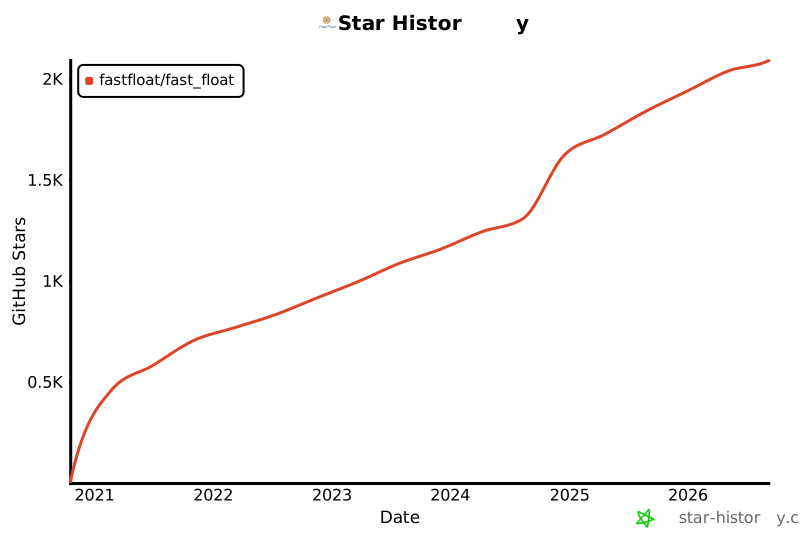
## Stars
|
||
|
||
|
||
[](https://www.star-history.com/#fastfloat/fast_float&Date)
|
||
|
||
## License
|
||
|
||
<sup>
|
||
Licensed under either of <a href="LICENSE-APACHE">Apache License, Version
|
||
2.0</a> or <a href="LICENSE-MIT">MIT license</a> or <a
|
||
href="LICENSE-BOOST">BOOST license</a>.
|
||
</sup>
|
||
|
||
<br/>
|
||
|
||
<sub>
|
||
Unless you explicitly state otherwise, any contribution intentionally submitted
|
||
for inclusion in this repository by you, as defined in the Apache-2.0 license,
|
||
shall be triple licensed as above, without any additional terms or conditions.
|
||
</sub>
|